
Arizona Has Lost $600 Million in SNAP Benefits. The Economic Warning Signs Are Emerging.
Nearly half of Arizona’s SNAP participants have lost their food assistance since July 2025, including roughly 180,000 children. That has removed more than $600 million in benefits from household budgets — and from the grocery stores, farmers markets, and local businesses where those dollars would have been spent.
The immediate human cost is clear: Families have less money to put food on the table. But emerging economic data suggest the damage may not stop there.
Across the country, households are buying fewer groceries, relying more heavily on credit, and seeking more food assistance. Grocery executives are reporting smaller purchases as customers carefully ration what they can afford. Arizona food banks are serving more people than they did even during the pandemic.
These are warning signs of a broader economic problem: When hundreds of thousands of Arizonans lose food assistance, communities lose spending, too.
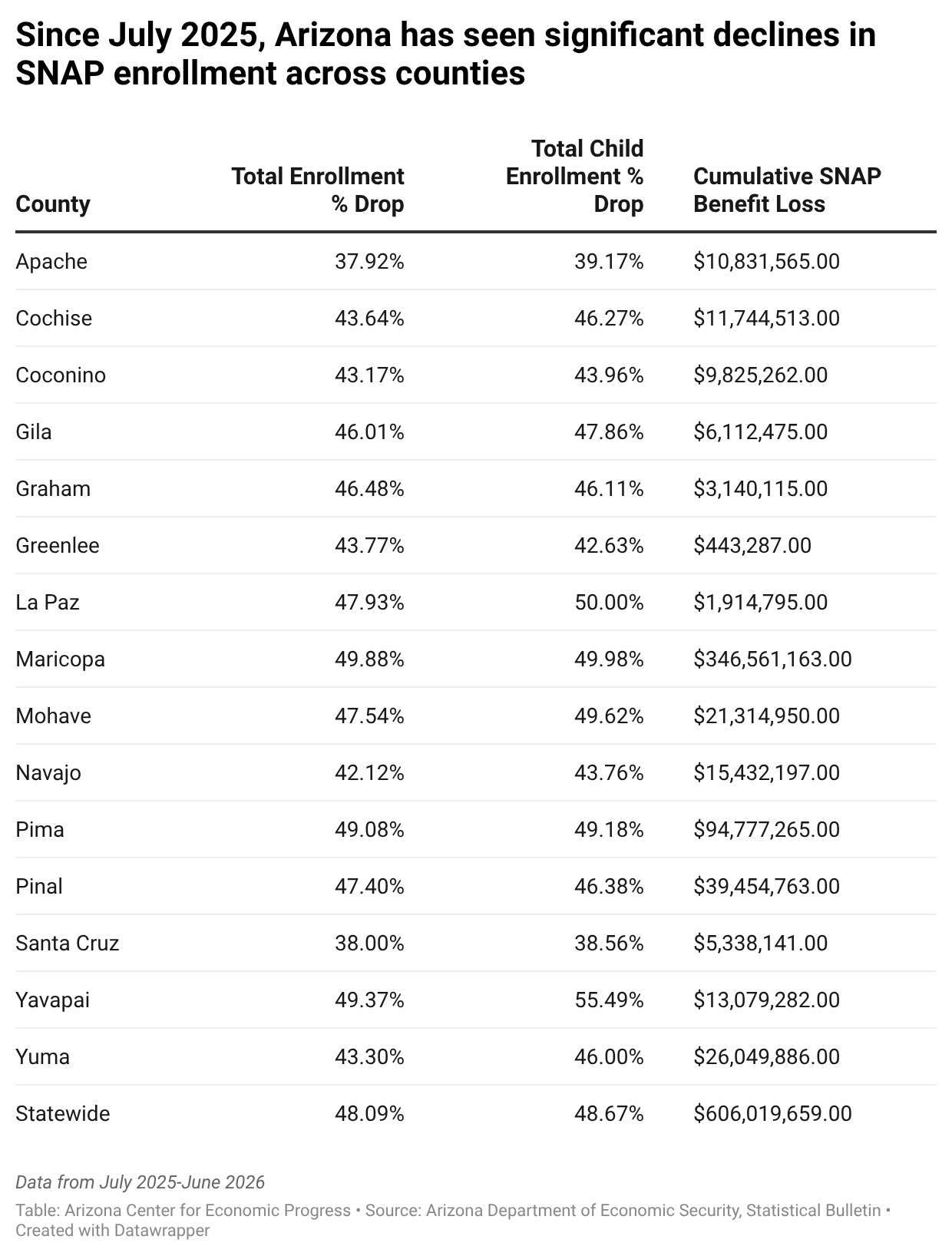
Families facing the greatest hardship are also facing higher costs
Headline inflation figures do not affect every household equally. Low- and moderate-income families spend a larger share of their budgets on necessities such as food, housing, utilities, health care, and transportation. When those costs rise, these families have fewer places to cut.
Rural households may face an even tighter squeeze. Recent data found that rural inflation was 0.79 percentage points higher than the national average. Rural residents can also be especially vulnerable to increases in gasoline prices because they often travel farther to reach jobs, schools, health care, and grocery stores.
Removing food assistance under these conditions does not eliminate the cost of feeding a family. It forces households to absorb that cost somewhere else or go without.
People are buying less and borrowing more
Evidence of that strain is beginning to appear in household and retail data.
After adjusting for inflation, national grocery-store sales have been largely stagnant in recent months. An analysis of NielsenIQ data found that the number of grocery items purchased fell 1.8% in June compared with the previous year. In other words, even as grocery bills remain high, people are taking less food home.
Financial stress is also increasing. A recent AARP Foundation survey of adults age 50 and older living below 250% of the federal poverty level found that 45% had run out of food before they could afford to buy more. The Urban Institute reported that in 2025, more than 1 in 4 working-age adults used credit cards to buy groceries and then had difficulty repaying the debt.
Arizona has also experienced rising debt delinquency in recent years, according to the Federal Reserve Bank of New York’s Household Debt and Credit Report.
Business and economic leaders are seeing the pressure firsthand.
“The customer is under pressure. High gas prices and reduced SNAP benefits are squeezing budgets. Customers are managing spend carefully and shopping with real intent. That pressure is showing up in the market.”
— Kroger CEO, first-quarter FY2027 earnings call
The Federal Reserve Bank of San Francisco similarly reported in its July 2026 Beige Book that demand for housing and food assistance remained elevated, while community contacts observed faster spending of tax refunds and rising credit card balances.
And the Federal Reserve Bank of Richmond heard from a grocery executive who was still seeing customers come through the doors — but with smaller baskets. Grocery-delivery purchases, which are more commonly associated with higher-income consumers, remained steady.
Together, these reports point to an increasingly divided economy: Lower-income households are cutting necessities and taking on debt, while higher-income consumers remain comparatively insulated.
The damage will not be evenly distributed
The economic consequences are likely to be most severe in communities where more residents rely on SNAP and Medicaid.
Research from the Economic Policy Institute found that counties receiving a larger share of personal income through SNAP and Medicaid also tend to have higher unemployment rates. These communities were already economically vulnerable before the loss of federal assistance.
Now they face several pressures at once: elevated prices, reduced food assistance, weaker household purchasing power, tariffs, changes in immigration policy, and growing uncertainty in the national economy.
SNAP benefits do more than help families buy food. They flow quickly into local economies because recipients generally spend them immediately at grocery stores and other food retailers. When those benefits disappear, the loss is felt not only at the kitchen table but also by the businesses and workers that depend on customers’ spending.
The evidence does not yet tell the full story of Arizona’s unprecedented SNAP decline. But the warning signs are becoming harder to miss.
Families are running out of food. Grocery baskets are shrinking. Credit-card balances and delinquencies are rising. Food banks are serving extraordinary demand. And more than $600 million that would have circulated through Arizona communities is gone.
The loss of SNAP is not merely a hardship for the families directly affected. It is an economic warning for the entire state — and Arizona policymakers should treat it as one.