Tag: budget

SNAP Losses Continue to Climb in Arizona, Driving Economic and Long-Term Damage Across the State 

More than 450,000 Arizonans have lost food assistance since 2025 as ripple effects hit families, local economies 

PHOENIX —  The number of Arizonans losing access to food assistance continues to grow, with more than 450,000 residents no longer receiving benefits through SNAP since July 2025, according to new analysis from the Arizona Center for Economic Progress. 

The sharp decline follows federal changes to SNAP eligibility under H.R. 1 and is already contributing to mounting economic strain across the state. 

“SNAP is one of the most effective tools we have to help families put food on the table and keep local economies moving,” said Joseph Palomino, director of AZCenter. “When hundreds of thousands of people lose that support, the consequences don’t stop at the dinner table — they ripple through our economy, our communities, and our future workforce.” 

The losses are especially stark for children. Since July 2025, nearly 196,000 fewer Arizona children are receiving SNAP benefits. 

Beyond the immediate impact on families, the reduction in SNAP benefits is already translating into measurable losses for Arizona’s economy. Since July 2025, the state has issued $346.8 million less in SNAP benefits than it would have if enrollment had held steady, resulting in an estimated $8 million to $32 million loss in state and local tax revenue. Research from the U.S. Department of Agriculture shows that every $1 in SNAP benefits generates about $1.54 in economic activity, meaning the broader economic losses are likely even greater.

“Cuts to SNAP don’t just increase hunger — they make it harder for families to stay housed, keep up with bills, and remain economically stable,” Palomino said. “At the same time, they take dollars out of local economies that businesses and workers depend on.” 

The long-term implications are even more significant — especially for children. Research from Columbia University finds that every $1 cut in SNAP benefits for families with children leads to $14 to $20 in long-term societal costs, driven by worse health outcomes, lower educational attainment, and reduced economic mobility. Even using a more conservative estimate, Arizona may have already incurred more than $800 million in long-term economic costs tied to SNAP losses for children alone. 

Arizona continues to face growing needs in areas like child care, housing, and public K-12 education, even as resources are constrained by years of tax cuts that have reduced available state revenue. 

Read the full analysis here

New Revenue Forecast Deepens Arizona Budget Challenges, Raises Stakes for Lawmakers  

PHOENIX —  Arizona’s budget outlook grew more strained today as the state’s Finance Advisory Committee (FAC) lowered revenue projections, further tightening the resources available to meet growing needs across the state to ensure a thriving economy. 

State economists now project Arizona will have $378 million available to spend this year — a nearly $200 million drop from the January estimate of $578 million. The revised forecast reflects increasing economic uncertainty tied to global instability and federal policy decisions, they said. 

“This update makes clear that Arizona is entering a more difficult fiscal environment at the exact moment when needs are rising,” said Geraldine Miranda, assistant director of fiscal policy at the Arizona Center for Economic Progress. “Lawmakers are facing a growing gap between what the state has and what Arizonans need to get by and get ahead.” 

Even before the revised forecast, Arizona faced significant funding pressures across policy priorities, including: 

  • Up to $784 million for tax conformity tied to recent federal changes  
  • More than $300 million for developmental disability services  
  • $195 million to maintain state employee health insurance  
  • At least $183 million for K-12 building renewal
  • $50 million for rental assistance  
  • $45 million to prevent approximately 3,800 children per month from losing access to child care, but in actuality $160 million to eliminate the waitlist  
  • Funding for school meals, low-income student support, and higher education scholarships  
  • Resources needed to implement major federal policy changes, including H.R. 1  

Advocates say the tightening budget outlook underscores the long-term impact of past tax policy decisions. 

“Years of tax cuts have left Arizona with fewer tools to respond when the economy shifts or when families need support the most,” Miranda said. “Now, as revenue projections fall, those choices are making it harder to invest in the services that keep our economy affordable and strong and communities stable.” 

Arizonans continue to face rising costs for basic necessities, including child care, housing, and health care — all while the state must also plan for long-term investments in infrastructure like water and roads. 

Advocates point to revenue options that could help stabilize the state’s finances and support critical investments, including closing corporate tax loopholes and adopting more balanced, progressive tax structures. 

“Lawmakers still have a choice,” Miranda said. “They can continue down a path that leads to deeper shortfalls and harder cuts, or they can take a more balanced approach that ensures Arizona has the resources to meet this moment.” 

The FAC update comes as state leaders continue budget negotiations and consider how to address both immediate funding gaps and longer-term fiscal challenges. 

For more analysis on Arizona’s budget outlook and the impact of recent federal policy changes, read our latest blog: Arizona’s Budget Just Got Tighter — and the Stakes Got Higher

Arizona’s Budget Just Got Tighter — and the Stakes Got Higher 

Arizona’s Finance Advisory Committee (FAC) brought a clear message when they met Thursday: The state has less money to work with than expected — and the funding needed for Arizona to thrive and become affordable again isn’t getting any smaller. 

State economists revised revenue projections downward, citing economic uncertainty tied to global instability and federal policy decisions.  

Just a few months ago, Arizona lawmakers were told the state would have about $578 million available to spend this year. Today, that estimate dropped to $378 million — a $200 million reduction. 

At the same time, the list of urgent needs facing Arizona continues to grow. 

The reality: big needs, shrinking resources 

Even before today’s update, Arizona was already facing major funding gaps across essential services. Now, those challenges are even harder to ignore. 

Here’s just a snapshot of what’s on the table: 

  • Hundreds of millions needed for tax conformity tied to recent federal changes  
  • More than $300 million for developmental disability services  
  • $195 million to maintain state employee health insurance  
  • At least $183 million for K–12 school building repairs  
  • And that’s just the beginning. 

There are also more targeted, but no less critical, investments needed: 

  • Staffing and systems to ensure SNAP benefits are delivered accurately 
  • Child care funding to prevent 3,800 children per month from losing access  
  • Rental assistance to help families stay housed  
  • School meals and support for low-income students  
  • Resources to implement major federal policy changes, including H.R. 1  

Each of these represents real people, real families, and real consequences if the state falls short. 

This didn’t happen by accident 

Arizona’s budget challenges aren’t just the result of global uncertainty or one-off events. 

They are the direct outcome of years of policy choices. 

Repeated tax cuts — especially those that disproportionately benefit the wealthiest households and big corporations — have reduced the state’s ability to respond when needs rise or the economy shifts. 

Now, as revenue projections fall, those decisions are catching up with us. 

What’s at stake 

This moment is about more than balancing a budget. 

It’s about whether Arizona can: 

  • Keep child care affordable so parents can work  
  • Ensure students have safe, functioning school buildings  
  • Provide care for people with disabilities  
  • Maintain access to health coverage  
  • Help families afford the basics like housing and food  

Arizona’s population is growing. Costs are rising. Needs are increasing. 

The question is whether the state will keep up or fall behind. 

A different path is possible 

Lawmakers still have choices. 

Arizona can continue down the current path — one where revenues fall short and difficult cuts become inevitable. 

Or the state can take a more balanced approach by raising revenue in a way that reflects the realities Arizonans are facing today. 

That includes options like: 

  • Closing corporate tax loopholes  
  • Creating a more progressive income tax structure  

These are not abstract policy ideas. They are practical steps that would allow Arizona to meet its obligations and invest in its future. 

The bottom line 

Today’s FAC update is a warning sign. 

With less revenue available and significant needs ahead — including the implementation of major federal changes like H.R. 1 — the gap between what Arizona has and what Arizona needs is growing. 

The question now is not whether tough decisions are coming. 

It’s whether those decisions will move Arizona forward — or leave more families behind. 

What Arizona Gave up for the Flat Tax: A Child Tax Credit That Could Cut Child Poverty by Nearly a Third

Arizona chose a flat tax that overwhelmingly benefits the wealthiest households — and in doing so, gave up billions that could instead fund a refundable child tax credit and cut childhood poverty by nearly one-third

That tradeoff is at the center of new analysis from the Arizona Center for Economic Progress, with support from the Institute on Taxation and Economic Policy and the Center on Poverty and Social Policy at Columbia University. The question isn’t just whether the flat tax works — it’s what Arizona could achieve if those dollars were invested in families instead. 

Affordability increasingly out of reach, families left behind 

Today, 14.6 percent of Arizona children live in poverty.  

At the same time, rising costs of living are making it harder for working families to afford basics like housing, food, and child care, putting additional strain on household budgets.  

In the Phoenix metro area, the price of food at home rose 3.3 percent year over year from February 2025 to February 2026, while the price of medical care in Phoenix rose 6.9 percent over the same period. More recently, gas prices are up nearly 40 percent from a month earlier.  

According to the Economic Policy Institute, the average annual cost of infant care in Arizona in early 2025 was $15,625. Nationally, child care costs continue to grow faster than the rate of overall inflation.  

What a child tax credit would do 

A $2,000 state-level refundable child tax credit would directly address these challenges by putting money back in the pockets of Arizona families who need it most. 

Research shows that increasing family income leads to better outcomes for children, including improved health, higher educational attainment, and greater lifetime earnings. These gains translate into a stronger economy with higher productivity and increased future tax revenues. 

There are also immediate benefits: Reducing child poverty is associated with lower public costs in areas like health care and the criminal legal system, while helping families stay stable and avoid crisis. 

Who benefits from the flat tax — and who doesn’t 

The flat tax delivers its largest benefits to the highest-income households, while limiting the state’s ability to invest in policies that support working families. 

At the same time, Arizona now collects roughly the same amount in individual income tax revenue as it did in FY 2017, after adjusting for inflation — despite significant economic growth. 

And claims that the flat tax drives stronger growth or increases revenues are misleading and inaccurate. The compound annual growth rate of real GDP was stronger in the three years (2019-2021) before its implementation (partial implementation in 2022) as compared to the three years after (2022-2024).  

Additionally, sales tax revenue growth when adjusted for inflation has flattened since the flat tax was implemented and declined in FY 2023 — a year when Arizona lowered its top income tax rate from 2.98 percent to 2.5 percent. 

A closer look at GDP and sales tax revenue suggests that claims the flat tax has boosted Arizona’s economy are often overstated. Much of the recent growth is more likely tied to pandemic-era factors — federal stimulus, national productivity gains, a higher-valued stock market, and inflation — rather than state tax policy, especially when growth is measured in nominal terms. 

At the same time, IRS migration data shows that while Arizona continues to attract higher-income taxpayers, the rate of those earning over $200,000 moving into the state has declined over time — even after the shift to a flat tax. This suggests that post-pandemic migration was driven more by affordability than by tax rates. 

A question of priorities 

To better understand the stakes, researchers modeled the distributional impact of both policies — the flat tax and a child tax credit. The results make clear that this is not just a question of tax structure — it is a question of priorities. 

A flat tax primarily benefits the highest earners in Arizona while costing the state billions in foregone revenue.  

The Center on Poverty and Social Policy at Columbia University found that Arizona could lift 60,000 children out of poverty with a $2,000 refundable Child Tax Credit. The credit would be designed to reach working families, phasing out for higher-income households. 

Currently, Arizona has a $100 nonrefundable dependent tax credit for children under 17, where the credit does not phase out until a single/head of household filer’s AGI exceeds $200,000 or $400,000 for joint filers.  

Analysis from the Institute on Taxation and Economic Policy shows the proposal is focused on the households who need it most. In each of the bottom four income groups, 20 to 25 percent of households would receive a tax cut averaging $2,000 to $3,000. 

Meanwhile, some of the highest-income households would see a small tax increase —around $100 — as the credit phases out. 

The policy would cost $2.02 billion — less than the revenue Arizona would likely regain by reversing the flat tax. In other words, the state could fund a child tax credit and still invest in priorities like roads, water, education, and housing. 

Even then, Arizona’s top income tax rate would remain relatively low — below nearly half of all states. 

Reversing the flat tax is just one option. The state could also explore a more progressive corporate tax structure or a tax on ultra-wealthy households. 

Arizona can continue to prioritize tax cuts that disproportionately benefit the wealthiest households. Or it can choose to invest in policies like a child tax credit that reduce poverty, strengthen families, and build a more inclusive economy. 

A Rapid Loss of Food Assistance: 375K Arizonans Cut off From SNAP Benefits in 6 Months

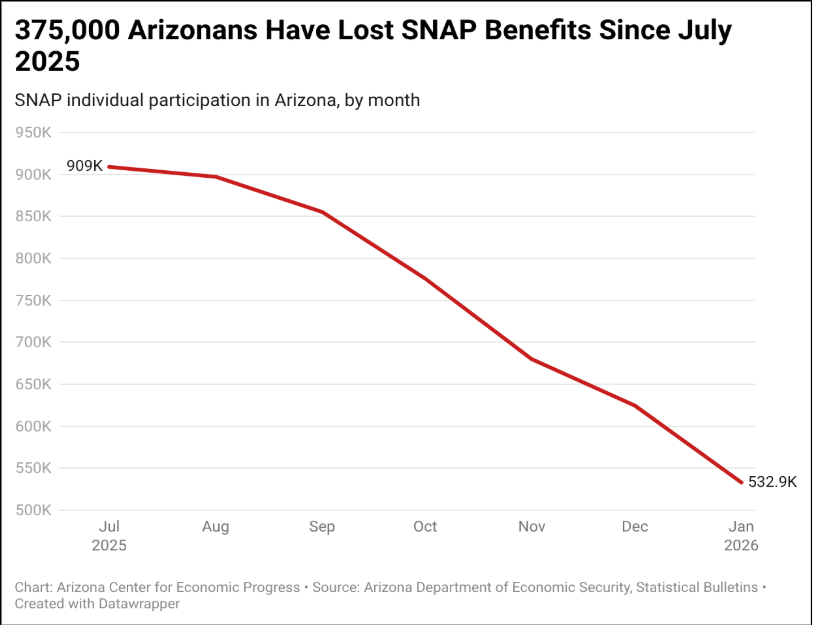
Arizona is experiencing a rapid erosion of access to SNAP benefits, and with it, a significant loss of food assistance for families across the state. In just six months, more than 375,000 Arizonans — including 160,000 children — have lost access to nutrition support they rely on to afford groceries. 

These graphs show how quickly participation has declined since July 2025, when H.R. 1 was signed into law, reflecting a sharp and sudden drop in benefits reaching households and communities across the state. The decrease is likely, largely, the result of changes made to SNAP as part of H.R. 1.

This scale of loss in such a short timeframe is deeply concerning.

SNAP is one of the most effective tools for reducing hunger and helping families afford groceries while also supporting local economies. When hundreds of thousands of people lose access to benefits, the effects extend beyond individual households, impacting grocery stores, food producers, and communities throughout Arizona.

Ensuring that eligible families can access nutrition assistance is critical for the health, stability, and economic well-being of the entire state.  

Arizona Lawmakers Try to Insert Sweeping, Previously-Failed SNAP Changes into Must-Pass DES Bill 

Amendment would add to affordability crisis in Arizona 

PHOENIX   A sweeping amendment to HB 2728 — the bill to continue the Arizona Department of Economic Security (DES) — would revive a series of controversial SNAP restrictions that lawmakers rejected earlier this session, while tying the future of a critical state agency to policies that could make it harder for Arizona families to afford groceries. 

The amendment, scheduled to be heard Wednesday in the Senate Health and Human Service Committee, dramatically expands what was originally a routine continuation bill for DES by inserting multiple provisions related to SNAP eligibility, work requirements, food purchase restrictions, and enforcement measures. 

Advocates say the move effectively attempts to push through SNAP policy changes that failed to pass as standalone legislation earlier in the session. 

“Arizona lawmakers debated many of these SNAP proposals already — which were vetoed by Gov. Hobbs,” said Joseph Palomino, director of the Arizona Center for Economic Progress. “Now they are being inserted into a must-pass continuation bill for DES, which risks holding an entire state agency hostage to policies that could make it harder for families to put food on the table.” 

SNAP helps hundreds of thousands of Arizona households afford groceries each month. Policy experts warn that changes to eligibility rules, work requirements, and administrative procedures could create additional barriers for families already struggling with high food prices and rising living costs. 

Key provisions in the amendment and their potential impact on Arizona 

Expanded SNAP eligibility verification 

The amendment requires DES to expand data matching with state and federal databases to identify potential changes in eligibility, including wage records, incarceration data, death records, and out-of-state EBT use. It would also require quarterly public reporting on fraud investigations, improper payments, and funds recovered. 

Why this matters: Arizona already conducts extensive eligibility verification under federal SNAP rules. Expanding these requirements would create additional administrative work for the Arizona Department of Economic Security and could slow benefit processing for eligible families. Additional reporting mandates may also divert staff resources away from helping families access food assistance and toward administrative compliance. 

SNAP work requirements 

The amendment prohibits DES from seeking or accepting federal waivers of work requirements for able-bodied adults without dependents unless required by federal law or authorized by the legislature. It also requires many SNAP recipients to participate in employment and training programs. 

Why this matters: Work requirement waivers are typically used during economic downturns or in areas with limited job opportunities. Preventing the state from requesting these waivers could cause thousands of Arizonans to lose food assistance even when jobs are scarce. Employment and training programs can be valuable, but mandating participation without adequate funding or program capacity could create barriers rather than pathways to employment. 

Restrictions on SNAP purchases 

The amendment directs DES to request a federal waiver allowing Arizona to restrict SNAP purchases of soda, candy, and other foods deemed to have minimal nutritional value. 

Why this matters: This policy could be difficult and costly to implement, requiring retailers to reprogram systems and enforce new rules at checkout. Similar proposals have rarely been approved at the federal level. Nutrition experts also note that restricting specific foods does not address broader barriers to healthy eating such as food access, affordability, and time constraints. 

SNAP payment error rate target 

The amendment requires Arizona to reduce its SNAP payment error rate to 3 percent or lower by 2030 and submit quarterly progress reports to the legislature. 

Why this matters: The SNAP payment error rate does not measure fraud; it measures whether benefits were issued in the exact amount households were eligible for under SNAP’s complex rules. Many errors are caused by administrative complexity rather than misuse. Setting an aggressive target could encourage overly strict eligibility decisions or delays that make it harder for eligible families to receive benefits. 

EBT monitoring requirements 

The amendment requires investigations when SNAP recipients repeatedly request replacement EBT cards and increases monitoring of out-of-state EBT spending. 

Why this matters: While program integrity is important, additional monitoring requirements may create burdens for recipients who legitimately need replacement cards due to theft, loss, or electronic benefit transfer skimming. Increased investigations could also require additional administrative resources without significantly reducing program misuse. 

Hospital immigration status reporting 

The amendment requires hospitals to collect voluntary information about whether patients are citizens, lawfully present, or not lawfully present and report aggregated data to the state. 

Why this matters: Public health experts warn that collecting immigration status information in medical settings can discourage people from seeking care when they need it. Even when the information is voluntary, policies like this may create fear or confusion for patients and complicate hospital administrative processes. 

Concerns about the amendment 

Because the provisions are attached to the bill continuing DES, the amendment could complicate passage of legislation necessary for the agency to remain operational. 

DES administers a wide range of programs that Arizona families rely on, including food assistance, unemployment benefits, child care assistance, and services for older adults and people with disabilities. 

“Continuation bills are meant to keep essential government services running,” Palomino said. “Using one to force through controversial SNAP policies risks turning a routine agency continuation into a political standoff with real consequences for Arizona families.” 

What SNAP’s Payment Error Rate Really Means — and Why It Matters for Arizona  

The Supplemental Nutrition Assistance Program (SNAP) helps hundreds of thousands of Arizona families afford groceries. Recently, federal policymakers have increased scrutiny of SNAP’s “payment error rate,” including proposals that would require states to significantly reduce these rates or face financial penalties.  

Under H.R.1, states with higher payment error rates would be required to begin paying a share of SNAP benefits, a cost states have never seen before, as SNAP is a federal program and always has been fully funded by the federal government.  

But the way this metric is often discussed can be misleading.  

The payment error rate does not measure fraud, abuse, or misuse of the program; it measures whether households received the exact benefit amount they were eligible for under SNAP’s complex eligibility rules. 

Understanding what this metric actually captures is important for developing responsible policy and accurately evaluating how the program works.  

What the SNAP payment error rate measures 

Each year, the U.S. Department of Agriculture (USDA) reviews a sample of SNAP cases in every state to determine whether benefits were calculated correctly through the program’s quality control system

USDA uses this review process to measure whether participating households received the correct SNAP benefit amount based on program rules. 

These errors include both overpayments and underpayments. Therefore, the error rate reflects situations where a household received slightly more than they should have as well as cases where a household received less than what they qualified for.  

Errors may occur because of administrative complexity or routine changes in household circumstances such as fluctuating income, irregular work hours, or delays in paperwork. The metric measures payment accuracy, not intentional misuse of the program.  

Additionally, the payment error rate does not include instances in which states improperly deny or terminate SNAP benefits for a household that was eligible.  

What the data shows in Arizona  

According to the U.S. Department of Agriculture, Arizona’s SNAP payment error rate was about 8.8 percent in fiscal year 2024, below the national average of 10.9 percent

In August 2025, roughly 900,000 Arizonans relied on SNAP to help afford groceries. By January 2026, SNAP participation had fallen to 533,000 Arizonans. Because SNAP serves such a large number of households, even small changes in income, hours worked, or documentation can affect the payment accuracy calculation.  

SNAP error rates reflect complexity, not widespread abuse 

While improving payment accuracy is an important goal, SNAP’s structure makes extremely low payment error rates difficult to maintain.  

SNAP is a large national program with detailed eligibility rules and millions of participating households. Determining the correct benefit amount requires states to calculate income, household composition, deductions, and other factors that can change frequently.  

Several factors contribute to payment errors: 

  • SNAP eligibility requires detailed documentation 
  • Many households experience fluctuating income or work hours that affect benefit calculations  
  • Eligibility workers must process large volumes of cases and documentation 
  • Even small administrative mistakes can count as full errors during federal audits 

The changes from H.R. 1 come at a particularly bad time: From stubbornly persistent inflation to a fragile labor market, states are forced to lower error rates when such a program may need to act as an automatic economic stabilizer for families and communities. 

Because the payment error rate measures administrative accuracy rather than fraud, policy experts caution that focusing solely on lowering the rate may not address the underlying causes of errors.  

Instead, improvements such as simplifying program rules and strengthening administrative systems are more likely to improve accuracy while ensuring eligible families can access food assistance.  

What this means for Arizona 

State budget analysts have projected that Arizona’s 8.8 percent payment error rate from Fiscal Year 2024 could rise to roughly 10 percent in Fiscal Year 2025.  

If those levels persist when new federal policy takes effect, Arizona will be required to cover 10 percent of SNAP benefits. According to the Joint Legislative Budget Committee, the error rate will equal about $139 million per year in new state costs, roughly the same amount of funding needed to cover a year of in-state tuition for more than 10,000 students at Arizona’s public universities.  

SNAP Policy Changes Are Still Unfolding in Arizona — Here’s What to Know 

A few months ago, SNAP was dominating headlines as shutdown-related disruptions left families at risk of losing access to food assistance. While attention has shifted, the federal policy changes, state legislative actions, and administrative challenges driving those conversations are still unfolding. These developments have profound implications for Arizona food security and families’ well-being.   

Here’s what’s happening with SNAP 
State legislative activity

Arizona lawmakers introduced several bills this session that tighten SNAP eligibility, increase monitoring requirements, and impose additional administrative responsibilities on the Arizona Department of Economic Security (DES). Most recently, a sweeping floor amendment to HB 2728, the bill to continue DES, incorporates many of the restrictive proposals that have been debated throughout the session.  

Specifically, it would: 

  • Require the state to reduce SNAP’s payment error rate — a measure of over- and under-payments states make — to 3 percent; a threshold widely viewed as unrealistic given how the federal error rate is calculated. 
  • Mandate employment and training participation for many SNAP recipients. 
  • Prohibit the state from seeking or using flexibilities or waivers for able-bodied adults without dependents (ABAWDs) unless explicitly authorized by state law. 
  • Expand data-matching and verification requirements, requiring frequent cross-checks of SNAP eligibility against multiple state and federal databases.  
  • Require monitoring of out-of-state EBT transactions, triggering investigations when spending patterns exceed certain thresholds. 
  • Direct the state to pursue federal waivers restricting certain SNAP purchases, including sugar-sweetened beverages and other items. 
Federal policy changes  

H.R. 1, signed into law in July, made major structural changes to SNAP. While the law was enacted last year, its full impacts are still emerging as states begin implementation, funding shifts take effect, and eligibility changes ripple through local economies. The changes from H.R. 1 include: 

  • Eligibility restrictions: Eliminates SNAP eligibility for certain refugees and asylees unless they attain lawful permanent resident status.  
  • Expansion of work requirements: Extends mandatory work requirements to adults ages 18-64 without dependents. 
  • Administrative cost shifts: States’ share of SNAP administrative costs increases from 50 to 75 percent, meaning Arizona must cover a substantially larger portion of eligibility processing, case management, and oversight costs. 
  • Future benefit cost shifts: While SNAP benefits have been historically paid fully by the federal government, H.R. 1 will now require states to cover a portion of SNAP benefits based on each state’s payment error rate. These cost shifts will begin in FY 2028.  
What it means 
  • Declining SNAP participation: Recent state data show that SNAP participation in Arizona has already been declining. According to the Arizona Department of Economic Security Statistical Bulletin (January 2026), SNAP participation has fallen by tens of thousands of participants from recent peak levels. This reflects a plethora of issues including expiration of emergency allotments, renewed eligibility reviews, increased documentation requirements, and administrative procedural closures.  
  • Increased churn risk: Stricter eligibility criteria and work requirements may lead to more Arizonans cycling on and off SNAP, disrupting food security, and increasing administrative burdens. 
  • Fiscal implications: Arizona’s SNAP payment error rate in FY 2024 was 8.84%, surpassing the 6% threshold set by H.R. 1. If the rate remains above that threshold, Arizona could face federal penalties that require the state to cover a share of SNAP benefit costs, which could cost Arizona $139 million in fiscal year 2028. 
What we’re watching  
  • Implementation and administrative rulemaking: We are closely monitoring how the Arizona Department of Economic Security (DES) translates legislative changes into administrative rules, guidance, and eligibility procedures, including how new verification requirements may affect case closures and benefit delays. 
  • Procedural closures & administrative accuracy: Beyond the participation totals, we are closely tracking rates of procedural case closures, reapplication patterns (churn), processing times and backlog trends, and county-level disparities in benefit access. 
  • Downstream economic & food security impacts: SNAP is an economic stabilizer. We’re looking out for how policy changes will affect local grocery spending, rural communities, and demand on food banks and emergency food systems across the state.